Funding the Shift: Environmentally Sustainable Rail by Design
Public investment in rail is increasingly focused on modernizing freight and passenger networks in ways that are safer, cleaner, and more connected. Current programs emphasize projects that improve rural and regional access, remove dangerous at grade crossings, and add capacity where it’s most needed, while reducing impacts on nearby communities. New rail infrastructure, line extensions, industrial spurs, intermodal connectors, and grade separations are now seen as a key tool for meeting economic and environmental goals. Shifting more freight and passengers to rail cuts emissions, supports more efficient supply chains, and improves overall safety, making rail central to state and federal sustainable transportation strategies.
The Infrastructure Investment and Jobs Act (IIJA) significantly expanded grants and financing for public agencies, railroads, and public private partnerships and sunsets at the close 2026. These funding tools have accelerated interest in rail construction and expansion, especially for projects that clearly demonstrate environmental benefits such as lower greenhouse gas emissions, improved air quality, fewer vehicle miles traveled, and reduced local impacts. Reinforcing this direction, many federal programs are prioritizing projects that are ready to move from planning to construction and can show measurable public benefits. Successful efforts are typically well defined, coordinated early with communities and stakeholders, and able to deliver on safety, reliability, and environmental performance.
Successful rail grant applications highlight clear environmental outcomes alongside traditional benefits. Funders look for credible emissions reductions, stronger stormwater and watershed protection, cleanup or reuse of older rail properties, and thoughtful siting and design. Competitive projects come from capable sponsors with strong partnerships, a realistic environmental review and permitting strategy, alignment with state and federal rail and transportation plans, and a blended funding approach that maximizes public value.
Early engagement with the Federal Railroad Administration (FRA), State Transportation Departments (DOTs), Metropolitan Planning Organizations (MPOs), and private rail partners are critical to bring environmental considerations into projects from the start and strengthens applications. As a result, well planned rail investments are strong candidates for public funding, delivering safety and economic benefits while cutting emissions, restoring environmental quality, and advancing long term sustainability.
By aligning project scope with funding priorities and pairing grants with innovative financing, sponsors can improve feasibility, accelerate delivery, and realize multi-faceted environmental outcomes. Rail investment is no longer just about adding capacity; it is about building a cleaner, safer, and more resilient transportation system for the long term.
Included in this newsletter are current primary federal, state (Florida as an example), and complementary financing mechanisms available for new railroad installations, highlighting eligibility and strategic considerations and presenting best practices for positioning projects for award. (1)
Federal Grant Programs Supporting Railroad Construction & Improvement
GRADE CROSSING SAFETY & IMPROVEMENT
- Railroad Crossing Elimination (RCE) Program
The RCE program funds grade-crossing projects that improve the safety and mobility of people and goods. Eligible projects include grade-crossing elimination or separation, track relocation, improvement or installation of protective devices, or other methods to improve safety. The program includes a 3% set-aside for planning projects and a 0.25% set-aside for crossing safety and education programs and can be layered with CRISI for corridor level rail investments. - Railway-Highway Crossings (Section 130 Program)
The Railway-Highway Crossings program typically provides $245 million per fiscal year as formula grants for grade-crossing projects. Additional reforms from the IIJA increased the maximum federal share for projects to 100% and incentive payments for crossing closures from $7,500 to $100,000. It also made eligible the replacement of functionally obsolete warning devices and allowed states to use funding to reduce trespassing fatalities and injuries. As the IIJA sunsets at the close of 2026, these enhancements may not continue. - Safe Streets and Roads for All (SS4A)
The IIJA established the SS4A competitive grant program with $5 billion in appropriated funds over five years, 2022- 2026. The SS4A program funds regional, local, and Tribal initiatives through grants to prevent roadway fatalities and serious injuries. The FY 2025 Notice of Funding Opportunity is live now, with applications due May 26, 2026, at 5 p.m.
RAIL & MULTIMODAL
- Consolidated Rail Infrastructure and Safety Improvements (CRISI)
Administered by the Federal Railroad Administration (FRA), CRISI is the primary federal grant program for rail infrastructure investments, supporting projects that improve the safety, efficiency, and reliability of freight and intercity passenger rail service. It is the only federal program for which short line railroads are directly eligible and is available to public agencies and public-private partnerships (P3), typically requiring a 20% non-federal match. CRISI supports:- New rail line construction and extensions
- Rail spurs and sidings serving industrial and port facilities
- Track relocation and capacity expansion
- Intermodal connectors and yard improvements
- BUILD (Formerly TIGER, RAISE)
BUILD is one of the few DOT discretionary programs for which regional and local governments can directly compete for multimodal transportation funding. It will receive $1.5 billion annually through 2026 for projects judged by their impact on safety, sustainability, quality of life, economic competitiveness, state of good repair, innovation, and partnership between the public and private sectors. The program supports multimodal transportation projects with significant regional or national impact. New railroad installations that connect ports, industrial districts, or logistics hubs are strong candidates when benefits extend beyond a single jurisdiction. - Infrastructure for Rebuilding America (INFRA)
This USDOT-wide program provides funding for highway and freight projects of national or regional significance. USDOT entertains INFRA applications for projects that apply innovative technology, delivery, or financing methods with proven outcomes to complete projects in a cost-effective manner. INFRA was previously known as the Fostering Advancements in Shipping and Transportation for the Long-term Achievement of National Efficiencies (FASTLANE) Grant Program (FY 2016) and will support near-shovel-ready major rail expansions, freight bottleneck relief projects, and port-rail and interstate freight connectors. - National Infrastructure Project Assistance (Megaprojects or Mega)
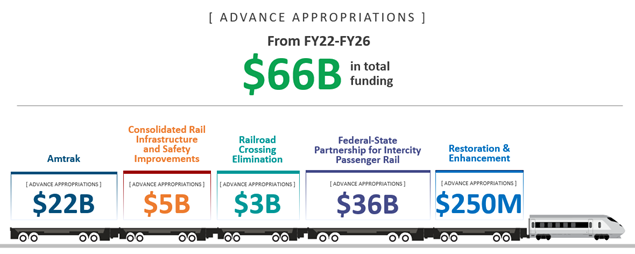
The Mega program supports large, complex projects that are difficult to fund by other means and likely to generate national or regional economic, mobility, or safety benefits. Freight rail projects are eligible, and the IIJA appropriated $5 billion for FY22-26. - Port Infrastructure Development Program (PIDP)
The PIDP is a discretionary grant program administered by the Maritime Administration (MARAD). It funds efforts by ports and industry stakeholders to improve port and related freight infrastructure to meet the nation’s freight transportation needs and ensure that port infrastructure can accommodate anticipated growth in freight volumes. - Rural Surface Transportation Grant
Rural Surface Transportation Grants support highway, bridge, or tunnel projects that increase connectivity, improve safety, and facilitate the movement of goods and people. Within an eligible highway safety improvement projects, it includes the construction and improvement of a railway-highway grade crossing safety feature, such as protective devices or grade separation. A rural area is defined as one that is outside an urbanized area with a population over 200,000. - National Culvert Removal, Replacement, & Restoration Grant
The IIJA established a culvert removal, replacement, and restoration grant program for projects that improve or restore fish passage for certain species, with priority given to those that are endangered or at risk of becoming endangered, or projects that address freshwater runoff that impacts certain marine life. The funding, $800 million annually through 2026, is available to states, local governments, and/or Tribes.
INTERCITY PASSENGER RAIL
- Corridor Identification and Development (ID) Program
Corridor ID supports passenger rail projects ready for funding, with an emphasis on improved coordination and faster implementation. Eligible projects include new or enhanced intercity passenger rail routes of less than 750 miles, service restoration on an existing route, and increased service frequency of a long-distance intercity passenger rail route. The program only funds pre-construction development and planning and the selection of corridors will reflect the FRA’s interest in advancing them to operation. Amtrak, state, regional passenger rail authorities, regional planning organizations, political subdivisions of a state, and Tribes are eligible applicants. - National Railroad Partnership (NRP) Program
Formerly known as the Federal-State Partnership for Intercity Passenger Rail, the NRP program funds capital projects that reduce repair backlog, improve performance, or expand or establish new intercity passenger rail (IPR) service, including privately operated intercity passenger rail service. The program emphasizes grade crossing projects and those focused on ensuring an obstacle-free travel experience, such as adding mothers’ and family restrooms, expanding waiting areas, creating children’s play areas, and other projects to improve the travel experience for families in intercity passenger rail stations. - Restoration and Enhancement Grant Program (REG)
REG is administered by the Federal Railroad Administration and offers operating assistance grants to initiate, restore, or enhance intercity passenger rail transportation. Eligible applicants include states, public agencies, political subdivisions of a state, or any rail carrier in partnership with another eligible entity.
TRANSPORTATION RESEARCH & DEVELOPMENT
- Strengthening Mobility and Revolutionizing Transportation (SMART)
SMART provides competitive grants to states, local governments, and Tribes for demonstration projects focused on advanced smart city or community technologies to improve transportation efficiency and safety. Grants may be used for coordinated automation, connected vehicles, intelligent/sensor-based infrastructure, systems integration, commerce delivery and logistics, drones, and smart grid technologies
Federal Financing Tools (Loans and Credit Assistance)
- Railroad Rehabilitation and Improvement Financing (RRIF)
RRIF provides low interest, long term loans for rail infrastructure, including:- New rail line construction
- Acquisition of rail facilities
- Major rehabilitation and expansion projects
- Transportation Infrastructure Finance and Innovation Act (TIFIA)
While traditionally highway focused, TIFIA can support rail related projects that demonstrate revenue generation or repayment capacity, particularly within public private partnership structures. TIFIA provides up to 49% of eligible project costs as credit assistance and targets large-scale projects. Funding amounts are set by Congress in the annual appropriation process.
State Funding * Florida Example
- Strategic Intermodal System (SIS)
Florida’s SIS program provides funding for rail projects that support intermodal freight movement and port and logistics connectivity, as well as capacity improvements on designated corridors. Short line railroads and public sponsors may be eligible with a typical 75/25 state local match. - FDOT Rail and Intermodal Grant Programs
FDOT administers targeted programs that support rail spurs serving industrial or aggregate facilities, intermodal logistics and supply chain resilience, and safety and capacity improvements on rail corridors. These programs are often well suited for projects that complement federal grant applications.
Funding Matrix: Project Elements vs. Eligible Programs
| Project Element | CRISI (FRA) | RCE (FRA) | RAISE / BUILD (USDOT) | INFRA / Mega (USDOT) | RRIF (FRA Loan) | State: Florida SIS / FDOT Rail |
|---|---|---|---|---|---|---|
| New Rail Line Construction (Greenfield or Extension) | ✔ Eligible for construction of new rail lines, extensions, and system capacity projects [transportation.gov], [localinfra...ucture.org] | △ If tied to crossing elimination | ✔ If multimodal and regionally significant [gorail.org] | ✔ Large scale, nationally significant corridors [transportation.gov] | ✔ Eligible capital cost for rail line construction | ✔ SIS designated corridors and intermodal connectors [transportation.org] |
| Industrial Rail Spur / Business Park Access | ✔ Explicitly eligible for freight rail access and economic development projects [transportation.gov] | — | ✔ If public benefit and economic impact are demonstrated [gorail.org] | △ If freight significance is regional/national | ✔ Loan eligible if revenue supported | ✔ FDOT rail and intermodal grant programs support spurs [islandchamber.com] |
| Track Relocation | ✔ Eligible safety and capacity improvement activity [localinfra...ucture.org] | ✔ Primary eligible use for crossing elimination [metro-magazine.com] | ✔ If improves community safety/mobility | ✔ If tied to major freight bottleneck | ✔ Eligible | ✔ If consistent with state rail plans [fdotwww.bl...indows.net] |
| Rail Yard / Terminal Construction or Expansion | ✔ Capacity expansion and intermodal improvements eligible [transportation.gov] | — | ✔ Strong fit for freight and logistics hubs [gorail.org] | ✔ If nationally or regionally significant | ✔ Eligible capital costs | ✔ SIS freight terminals and logistics facilities [transportation.org] |
| Port Rail or Intermodal Connector | ✔ Eligible for port and intermodal access projects [transportation.gov] | — | ✔ One of the strongest RAISE use cases [gorail.org] | ✔ INFRA/Mega freight priority [transportation.gov] | ✔ Eligible | ✔ Core SIS eligibility category [transportation.org] |
| Grade Crossing Elimination / Separation | ✔ Eligible when part of broader rail improvements [localinfra...ucture.org] | ✔ Primary purpose of program [metro-magazine.com] | ✔ If multimodal safety benefits shown | △ If part of major corridor | ✔ Eligible | ✔ FDOT rail safety and SIS programs [fdotwww.bl...indows.net] |
| Signal Systems / Safety Technology | ✔ Eligible safety and reliability improvement [transportation.gov] | ✔ If crossing related | ✔ If community safety benefit | △ | ✔ Eligible | ✔ FDOT rail safety initiatives [fdotwww.bl...indows.net] |
| Planning, Environmental Review, and Design | ✔ Dedicated CRISI planning tracks available [localinfra...ucture.org] | ✔ Up to set aside for planning [metro-magazine.com] | ✔ Pre construction activities eligible | ✔ Early development for major projects | △ Limited | ✔ State rail planning support [fdotwww.bl...indows.net] |
| Public Private Partnership (P3) Rail Projects | ✔ Strongly encouraged structure [transportation.gov] | △ | ✔ Competitive advantage | ✔ Preferred for large projects | ✔ Core use case for RRIF | ✔ Common for FDOT rail projects [islandchamber.com] |
Legend: ✔ = Clearly eligible | △ = Conditionally eligible | — = Generally not applicable
How to Use This Matrix Strategically
- Bundle funding: Use CRISI or RCE for grants and RRIF for gap financing.
- Sequence applications: Planning/design under CRISI → construction under CRISI/RAISE → long term financing with RRIF.
- State federal alignment: Position FDOT SIS funding as match for federal discretionary grants.
- Strengthen competitiveness: Emphasize safety, freight efficiency, emissions reduction, and economic development benefits across programs.
References
- Funding program information from GoRail.org. Please note that our federal and state funding landscape is constantly changing; users are encouraged to check the latest legislation and funding opportunities available.